Showing posts with label homeschool. Show all posts

Tuesday, October 12, 2010

Fun at the Firehouse

Today, in honor of fire prevention month our pre-school co-op took a field trip to the fire station.  The children learned about fire safety from a wonderful volunteer firefighter...and then he started up the truck and let them explore!  They had a blast...O particularly loved pretending to drive. 


After the children stopped using the firetruck as a jungle gym the fireman let loose a torrent of water.  The air was filled with the squeals of delighted children.  It is always an added bonus when education becomes joyful!  I love the real life experiences the children get with homeschool!

Monday, September 13, 2010

First Day of School and Our Schultüte

Well, today was the day...Back To School!  Each year we kick off the first day of school with a schultüte.  Schultütes are a German tradition that date back to the 1810. 


On their first day of school German kids receive a schultüte, which is a large cardboard cornet filled with sweets and little presents.  When we decided to homeschool I wanted to find a tradition we could adopt to make our first day back exciting and special.  I started searching for back to school traditions and came across the schultüte.  I made them last year and they were a huge hit with the kids...T has been asking me for weeks when he was going to get his cone:)  They are very easy to make.  First I twisted a large sheet of poster board into a cone shape.  Then I hot glued it together and trimmed the top to make it level all the way around.  Next I tapped wrapping paper onto the outside, and placed tissue paper around the top.  Finally you stuff it full of goodies and affix a ribbon.  Our cones were filled with school supplies, snacks, stickers, one back to school outfit, and a small toy.  Here is a tutorial I found if you want more details and pictures.  

We had a very successful day without ANY complaining or foot dragging. So...... 1 day down, and 179 days to go:)

Friday, September 10, 2010

Our Curriculum for 2010-2011

We are all excited to begin our school year this Monday....and by we I mean me:)  After hours of research I have finally decided on our curriculum choices for this year.  So without further adieu here they are:

Language Arts
The Ordinary Parents Guide to Teaching Reading
First Language Lessons for the Well Trained Mind Grade 2
Writing With Ease levels 1 and 2
MCP Plaid Phonics

Literature and Readers

Sonlight Core 2 read alouds
Sonlight Core 2 regular readers

Spelling
All About Spelling Level 1

Math
Singapore Math 2A and 2B
Math Mammoth  Grade 2 (supplement)

History
Story of the World Vol. 2
Story of the World Vol. 2 Activity Guide

Science
Elemental Science Earth and Space
Handbook of Nature Study and the Outdoor Hour Challenge

Handwriting
Handwriting Without Tears Grade 2

Whew sounds like a lot.....we will also be participating in an art co-op twice a month using Artistic Pursuits and attending a homeschool PE class weekly. Later this week I will be posting our weekly schedule.
 I'm sure your all wondering how one can fit this all in with three children and at work from home business....I know I am:)

Sunday, September 5, 2010

A Homeschool Schedule Ephiany

We were planning to start our 2010-2011 homeschool year this coming Monday 9/6. However life, and out of town doctor’s appointments have gotten in the way. I will have to push back our start date to the following Monday 9/13. This late start was giving me much angst last night until I had a light bulb moment....we could switch to year round homeschooling. The more I thought about it the better it seemed. I ran the logistics through my head all night and this morning put it all down on paper. I think this is the answer to many of the homeschool challenges we faced last year...namely BURNOUT.
Our new schedule will consist of mainly six week school sessions with one week breaks in between. The exceptions will be two week breaks at Christmas and birthdays, and a six week break for summer. This works out to 36 weeks of school and 14 weeks of breaks. It will leaves us with 2 extra weeks of breaks to use throughout the year for floating holidays or just life happenings :)

So here is a rough sketch of our new academic calendar:

Sept. 13-Oct. 22     6 weeks school
Oct. 23-Oct. 31      1 week break
Nov. 1-Nov. 19      3 weeks school
Nov. 20-Nov. 28    1 week break
Nov. 29-Dec. 17    3 weeks school
Dec. 18-Jan. 2        2 week break
Jan. 3-Feb. 11        6 weeks school
Feb. 12-Feb. 20     1 week break
Feb. 21-Apr. 1       6 weeks school
Apr. 2-Apr. 17       2 week break
Apr. 18-May 27     6 weeks school
May 28-Jun. 5        1 week break
Jun. 6-Jul. 1            4 weeks school
Jul. 2-Jul. 10           1 week break
Jul. 11-Jul. 22         2 weeks school
Jul. 23-Sept.2         6 week break

I am happy to have one more week to get things organized for the school year and this schedule really fits our family dynamics so much better than the traditional school calendar. I have high hopes for a successful year now!

Wednesday, May 12, 2010

OHC Spring Series #5: Year-Long Cattail Study

This week we completed the OHC spring series #5: Year Long Cattail Study.  We began our cattail study in the winter. Here are some pictures of our cattails from our winter study.

We were excited to see the seasonal changes at out study location.  The cattails leaves were a lush green. 
The children were also able to quickly identify the vast difference in the water and surrounding vegitation of our study site.  This colony of cattails grows in a marshy wetland near the banks of a river. 
We also saw remnants of last years flowering spikes peppered amongst the new growth. 


The austere brown stalks offered a sharp contrast to the verdant new life which surrounded them. I loved how this study enabled the children to witness the life cycle of nature first hand. We look forward to continuing this study throughout the year. I can wait until the flower spikes emerge!

Tuesday, May 11, 2010

Ancient American Civilizations

This week in history we are studying ancient American civilizations.  We began our study with the nazca culture which flourished from the first to eighth centuries AD beside the dry southern coast of Peru.  The Nazca culture is renouned for their large geoglyphs.  The geoglyphs of Nazca or "Nazca lines" are a series of geometric shapes, miles of lines, and large drawings of animal figures (some as large as a football field) constructed on the desert floor in the Nazca region.  The hundreds of individual figures range in complexity from simple lines to stylized hummingbirds, spiders, monkeys, fish, sharks or orcas, llamas, and lizards.

According to Wiki: The lines are shallow designs made in the ground by removing the  reddish pebbles and uncovering the whitish ground beneath. Hundreds are simple lines or geometric shapes; more than seventy are designs of animal, bird, fish or human figures. The largest figures are over 200 metres (660 ft) across. Scholars differ in interpreting the purpose of the designs, but they generally ascribe religious significance to them, as they were major works that required vision, planning and coordination of people to achieve. Here is an example of a monkey geoglyph.


As part of our study T designed and drew his own geoglyphs.

We also briefly studied the Olmec culture which were an ancient Pre-Columbian civilization living in the tropical lowlands of south-central Mexico.  The most familiar aspect of the Olmecs is their artwork, particularly the aptly-named colossal heads.  As no known pre-Columbian text explains them, these impressive monuments have been the subject of much speculation. Once theorized to be ballplayers, it is now generally accepted that these heads are portraits of rulers, perhaps dressed as ballplayers. Infused with individuality, no two heads are alike and the helmet-like headdresses are adorned with distinctive elements, suggesting to some personal or group symbols. There have been 17 colossal heads unearthed to date.  According to Wiki the heads range in size from the Rancho La Cobata head, at 3.4 m high, to the pair at Tres Zapotes, at 1.47 m. It has been calculated that the largest heads weigh between 25 and 55 tons.

The heads were carved from single blocks or boulders of volcanic basalt, found in the Tuxtlas Mountains.  Here is an example of an Olmec Head.


T constructed his own Olmec head out of playdoh.


We plan on studying ancient American civization more in depth in the coming weeks.  T seems especially interested in them due to their close geographic proximity.

Tuesday, April 20, 2010

Playful Learning

After the hectic weekend of birthday revelry, Monday morning was looking pretty grim. The natives were restless and extremely resistance to doing anything that remotely resembled "school". So I threw my lesson plans out the window and broke out the games. I have to thank Kat from Stuff on My Blog for this wonderful M&M math activity. We graphed each color of M&M comparing the quantities and making simple word problems based on color distribution. We also used the M&M to construct patterns, practice skip counting and illustrate basic multiplication and division. You have to love school supplies that are edible!


We also played sight word bingo and phonogram bingo. I called each sight word and phonogram out to T who than had to locate them on his bingo card. O was very determined to join in the fun. To facilitate this after I had called out the word/sound to T, I placed the card in front of O and she would search for the duplicate word on her bingo card.

We rounded out the day with some read alouds and T reading a Star Wars book to me. Did the day go as planned....No.  Instead we had a day filled with laughter, fun, and learning....Score!

Thursday, April 15, 2010

OHC Spring Series #1: Year-Long Tree Study

This week we continued with the Outdoor Hour Challenge Spring Series #1: Year Long Tree Study. We stretched this study over a two week period so we could observe the buds opening and the leaves emerging.  Each of the children have their own trees to study, T's is a Kousa Dogwood and O's is a Bloodgood Maple. We began this study in the winter and will continue it through the year.

First up is the Bloodgood. Over the last two weeks the leaves have fully emerged and the foliage is just gorgeous. I love how the sunlight kisses the leaves igniting their color.


Next is the Kousa.  The leaves are just beginning to unfurl.  They should be fully emerged in the next two weeks.  Kousa dogwoods bloom later than their indigenous counterparts.  We have both native and imported dogwoods in our garden.  I can not wait for them to blossom, it is one of my favorite spring sights.

Thursday, April 1, 2010

On Island Time

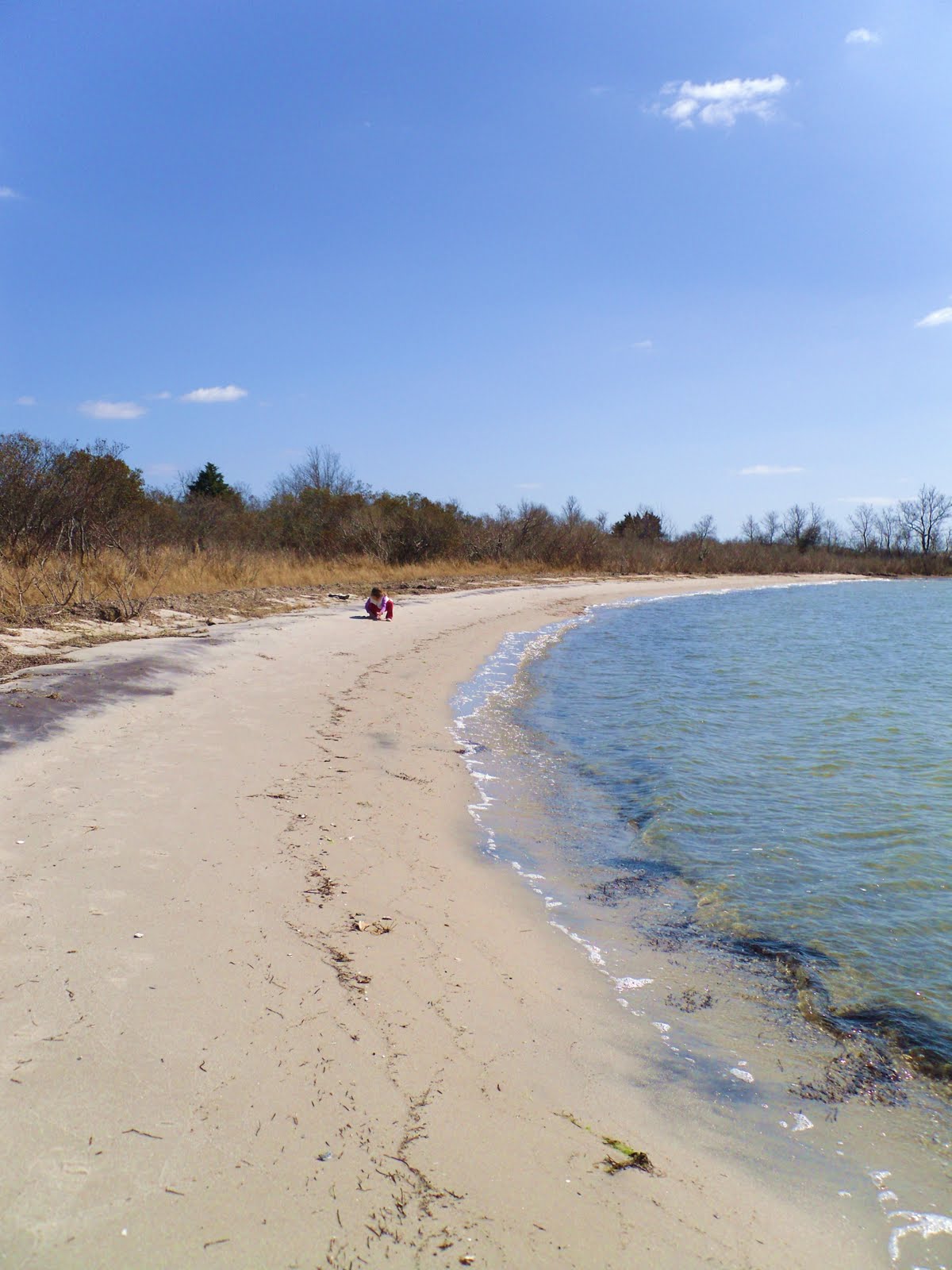
Yesterday was a glorious spring day here in the Mid-Atlantic. We took full advantage of the weather and visited our local barrier island.  This island has three half mile hikes that are perfect for small children.  We were able to do the salt marsh, and maritime forest hikes but were unable to do the dune hike because of recent storm flooding.  These hike are only doable for a few months each year....the flying insects are insaitable once it warms up!  


We also visited the island nature center and took full advantage of the touch tank. We are currently studying invertebrates in science and were able to observe echinoderms, mollusks and crustaceans in the nature centers aquariums.


We capped the day off with a frolic on the beach, where E got sand in his toes for the first time. I am so lucky to live in an area that boasts such an array of natural habitats. My little nature explores are always ready for their next adventure.

Monday, March 29, 2010

Raindrops Keep Falling on My Head

This mornings spring showers brought a welcome excuse to get wet and muddy!  While T was finishing up school O did a hands on weather study:) She merrily laughed as she jumped from puddle to puddle.  The grey skies certainly didn't put a damper on her spirits.

Later, T joined her to perform buoyancy experiments in our newly formed backyard lake. First we collected various yard objects: twigs, pinecones, leaves, barks, and stones. We then hypothesized which would sink and which would float. Objects that float are considered positively buoyant and inversely objects that sink are deemed negatively buoyant. The idea of buoyancy was summed up by Archimedes, a Greek mathematician, in what is known as Archimedes Principle: Any object, wholly or partly immersed in a fluid, is buoyed up by a force equal to the weight of the fluid displaced by the object. From this principle, we can see that whether an object floats or sinks, is based on not only its weight, but also the amount of water it displaces. Next we built craft stick rafts to further explore buoyancy.
We then added various objects to the rafts in order to determine how chaning an objects mass affects it's buoyancy.

I love how homeschooling allows me to turn even the most mundane object (puddles) into learning opportunities. We all had a blast and were amazed by how educational a good rain storm could be!


Tuesday, March 16, 2010

Mammals in Winter


This week challenge was to focus on winter mammals. During the winter many mammals become elusive. We are fortunate to live near a National Wildlife Refuge which provides an excellent locale for our weekly adventures. Today we were able to hike a trail and drive through the preserve on a "mammal hunt".  The children were very excited to discover multiple sets of deer tracks. Our area is heavily populated with white-tailed deer and this particular refuge is also home to an introduced Asian species the sika deer.  Based on the size of our tracks we were able to identified them as white tailed deer.  In addition to these tracks we spotted squirrels, and the scat of wild horses.  We also found these tracks but were unable to identify them due to their degradation.


We plan on continuing our mammals study throughout the spring in hopes of discovering more animals.